Notes on approaching the abundance of software

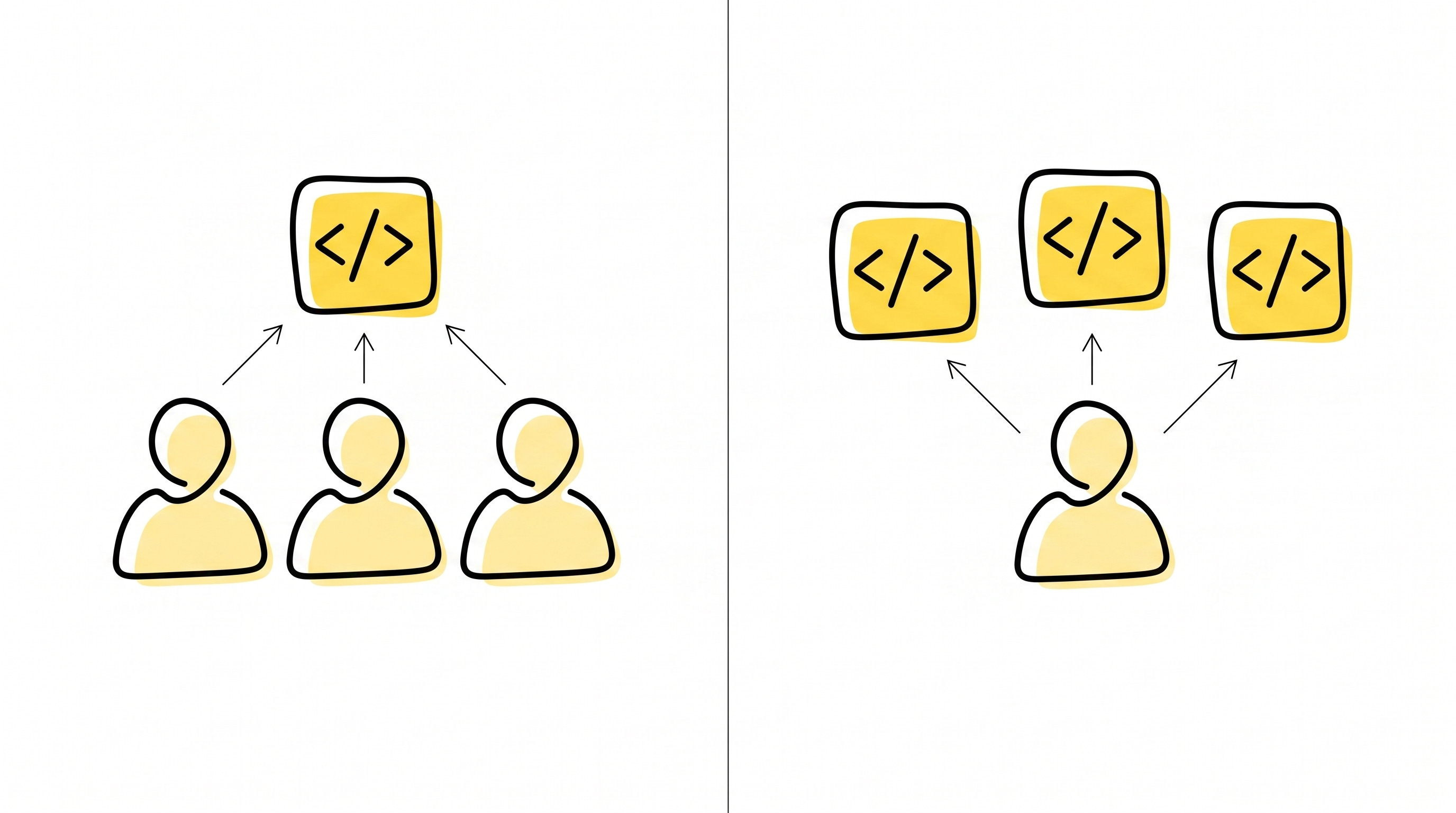
Most discussions about AI and software end up at one of the following:
AI can or cannot replace all software engineers
AI can or cannot write software for companies that are huge and offer complicated services
The objective of this article is to explore the other side - what such a thing does to humanity at scale. The idea is not to be predictive but inquisitive.
Software is now cheap and disposable
Going at scale and acquiring a million consumers is not the only reason for software to be written anymore. People are building software tools for much simpler use cases in their daily life. Some important, some very silly. A friend, who requested to be anonymous, built a beautiful poop tracker iOS app for himself. Another business owner friend is making mini invoicing software for his employees. These software nuggets serve their function perfectly within the bounds. All software need not stand the test of time for decades to prove valuable. The shelf life could now be just a few days or weeks. I’m observing this as I’m building mini tools to build the actual product I’m working on.
For building a usable software, the effort has gone from dozens of techies, millions in funding, and months in building to a weekend of vibe-coding. Unprecedented things have happened in the past whenever a barrier was brought down by this magnitude.
A parallel from history of motion pictures - while the first ever footages were captured to be aired on national television, video as a medium evolved to the point where you capture 23 photos of your dog knowing you won’t ever need them again. To capture something in the early days you would’ve needed cranes, budgets, manpower and more importantly, permission. Capturing a video is a form of free will that anyone can exercise right now. People made careers on it and we are right now living through a creator economy.
Almost every technology that you can perceive eventually became a means of self-expression - your own style of clothing, Instagram grid, reels, podcasts, posters, films, etc. With the power of photography unlocked in the 1800s, people in the 20th century use it as a means of art, storytelling, and to share their view of the world. The same goes to design, film, writing, music, or any creative form.
A very interesting question to ask would be how software could become a way of self expression. How can it become a part of human communication?
How can one share their thoughts through software, like they did with video or text? Even better, what’s the medium?
Software defined what was humanly possible
For the last 30 years, most people experienced software as something they could use, but never change. Software was expensive to build, difficult to distribute, and controlled by companies (who did their best). As users, we adapted ourselves to software and planned our days, weeks, and lives around them. This applies more for the knowledge workers and creatives who spend all their working hours on laptops. Over time, we stopped seeing these constraints as software limitations and started seeing them as facts of life.
Let’s take a hypothetical person with no hard skills whatsoever and ask them the following questions:
How fast can you put together a video edited to music beats?
How fast can you make a storyboard of the script in your mind?
How fast can you clear all your credit card bills?
How fast can you make a 3D model for your broken shower?
The answers to these questions vary from two minutes to six months, which is totally a function of the time it takes to learn and work on the tools of today - After Effects, Premiere Pro, Blender, Cred, Illustrator. This person may have to learn an entire tool just to get a simple thought out.
The internet software era optimized for averages owing to the resources it took to make them. You didn’t get software that perfectly fit your life. You got software that approximately fit everyone’s life.
With AI, the question changes from “Is it justified enough to build this feature?” to “What is the most customized solution that we can build for this problem?”

I’m seeing tools that I once paid for being built by people around me. A colleague built a Splitwise alternative called SplitFair for just our group for fair splitting of bills among drinkers and non-drinkers, and vegetarian and non-vegetarians. In the pre-AI world, the possibility of efficiently splitting bills completely relied on Splitwise team’s bandwidth, priority, and a multitude of other internal factors which the public won’t have control over. Yet, they defined humanity’s perceived possibility of an important task.
We shape our tools and thereafter our tools shape us.
It’s time to rethink almost everything
It really does look like a lot of the tools we know as giant software companies can go obsolete if some people decided to build better, more customized alternatives. There will be implications on how companies get funded, the pace of software updates, and the entire value chain of software as we know it.
To be honest, it doesn’t feel very comfortable having everything change so fundamentally. Some of my insights that I’ve gathered over the years don’t apply anymore. But on the flipside it feels like Iron Man’s nanotech suit is suddenly given to me. I don’t even know what to make with it. And it claims to do ANYTHING!
I hear people saying “Everyone thinks they are a coder now” like it is a bad thing. Maybe people in the 90s said the same thing about photography when it got digital. But there I was in 2017 with a DSLR in my hand and getting paid for actually providing value to some businesses without ever having to develop negatives in a dark room or go to art school.
The truth of supply and demand goes far beyond people’s imaginary borders.
So what do we do?
At this point, claiming to know or fully understand what’s happening would be the biggest hinderance for growth. It’s time to question pretty much everything around us and give an attempt at solving them - big or small.
Everything is up for a review. An audit. I already feel the editing tools need a major revamp after using Premiere Pro for 12 years now. Maybe that should be my next project.
The difficult thing to wrap our heads around is the fact that software is a new material now. It’s a word leading companies like Cursor and Figma are using to define software, and for good reason. You can make a thing of your own and that thing could be extremely useful or obscure.
Software is clay
It’s time to pull out all your notes. All your ‘what ifs’. All of those ideas deserve a second chance.
P.S. A friend told me that it would be wise to just check if someone else has already solved the problem in the last one month before you go ahead and build it.